Scaling X Ads campaigns is where most advertisers lose money. A campaign that looks great at $50 a day can collapse at $500 because the audience saturates, frequency climbs and costs spike. This guide lays out the scaling framework we use at Savoir Management for X (formerly Twitter): how to prove a winner, how fast to raise budgets, when to duplicate instead of increasing spend, and which metrics tell you to stop.
Why do X Ads get more expensive when you scale?
X Ads get more expensive at scale because a larger budget forces the system to reach beyond the people most likely to respond, and the same people see your ad more often. Both effects push cost per result up unless you add new audiences and new creative as you grow.
X is built on real-time conversation. Trends change within hours, and people scroll fast. An ad that matches today's conversation can feel stale next week. That makes X more sensitive to creative fatigue than search platforms, where intent stays constant.

What should you prove before scaling an X campaign?
Before scaling, prove that one audience and one creative hit your target cost per result for at least a week at a small budget. Scaling an unproven campaign only multiplies the loss.
Pick the right campaign objective first. X offers objectives for reach, video views, engagement, website traffic, app installs and conversions. If you sell online or collect leads, choose website traffic or conversions so X optimizes toward clicks and actions, not likes.
Then set a clear "micro-win" for each test:
Cost per lead or purchase below your target
Click-through rate above your account average
Enough conversions (we look for 20 to 30) to trust the result
How fast should you increase an X Ads budget?
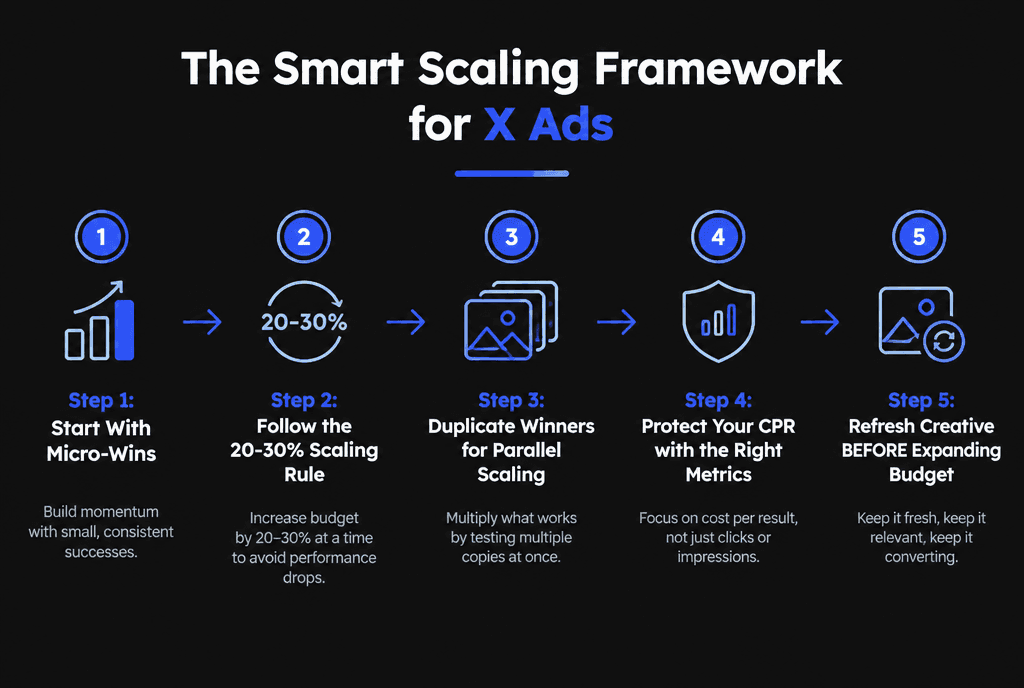
Increase a proven campaign's budget by 20 to 30% at a time, then hold for three to four days before the next step. Gradual increases let delivery stabilize, while doubling a budget overnight often spikes cost per result.
This "20 to 30% rule" is a practitioner guideline, not an X policy, but it holds across platforms that use automated bidding. Each change gives the system new spend to place, and moderate steps keep it inside the audiences that already convert.
Should you duplicate winning campaigns instead?
Yes. Horizontal scaling, which means duplicating a winning ad group into new audiences, grows reach without overloading one audience. Combine it with gradual budget increases on the original.
Good expansion audiences on X include:
Keyword targeting: people who recently posted or engaged with posts using your keywords.
Follower look-alikes: people similar to the followers of relevant accounts.
Interest and conversation topics: broader audiences built around topics your buyers follow.
Custom audiences: website visitors or customer lists for remarketing.
Launch each duplicate with the same creative that won, so you are only testing the audience.
How do you protect your budget while scaling?
Set cost caps or target costs where available, exclude converted customers, schedule ads for the hours your buyers are active, and review results daily during any budget increase. Protection rules matter more at scale because mistakes cost more per hour.
Exclude existing customers and recent converters from prospecting campaigns.
Separate prospecting and remarketing budgets so one does not starve the other.
Pause placements or audiences whose cost per result is more than 30% above target for three days.
For B2B offers, concentrate spend on business hours in your buyers' time zones.

Which metrics matter when scaling X Ads?
Track cost per result, conversion rate, frequency and click-through rate together. Rising frequency with falling click-through rate is the clearest early sign that an audience is saturated.
Make sure the X Pixel or conversion tracking is installed and reporting purchases or leads. Then review:
Cost per result: the number you scale against.
Conversion rate: if it drops while clicks rise, traffic quality is slipping.
Frequency: above three or four per week on prospecting, fatigue is likely.
Click-through rate: a falling CTR signals the creative needs replacing.
Tag every link with UTM parameters so Google Analytics confirms what X reports.
How often should you refresh creative on X?
Refresh creative every one to two weeks on active campaigns, and always before a major budget increase. Fresh creative restarts attention and keeps cost per result stable as reach grows.
Formats that hold up well on X:
Short native videos with captions, because many people scroll without sound
Image ads with one clear claim and a strong call to action
Conversation-style copy that reads like a post, not a billboard
Carousels that show several products or proof points
Test one variable at a time, such as the hook, image or offer, so you know what caused the change.

How should conversion tracking be set up before scaling?
Install the X Pixel or a server-side conversion integration, define the events that matter, such as purchases, sign-ups or leads, and confirm they fire correctly before increasing spend. Scaling without reliable tracking means scaling blind.
X's delivery system optimizes toward the actions you track. If conversions are missing, duplicated or attributed inconsistently, the campaign learns the wrong lessons and budget increases magnify the problem. Before each scaling step, place a test conversion, compare platform-reported results with your own CRM or store data, and investigate any large gap. Consistent naming of campaigns and UTM parameters on every link also makes it far easier to see which audiences and creative are driving real business.
How do audiences change as you scale on X?
Small, tightly targeted audiences saturate quickly when budgets grow. Scaling on X usually means widening reach in steps: adding related keywords and follower look-alikes, testing broader interests and letting proven creative find new pockets of people.
Signs an audience is saturating include rising frequency, falling click-through rate and climbing cost per result even though nothing else changed. Instead of forcing more budget into the same audience, add new targeting sets as separate ad groups so you can compare them:
Keyword targeting: terms people post and search about that relate to your product or problem
Follower look-alikes: people similar to followers of relevant accounts, publications or competitors
Interest targeting: broader topic categories, best tested once you have strong creative
Retargeting: website visitors and people who engaged with your posts, kept separate from prospecting
Give each new audience enough budget and time to show a result before judging it, and keep your best-performing original audience running as a benchmark.
How should landing pages keep up as spend grows?
More spend multiplies the impact of every weakness on your landing page. Before scaling, make sure the page matches the ad's promise, loads fast on mobile and makes the next step obvious.
Most X traffic arrives on phones, often from people scrolling quickly. A page that takes several seconds to load or opens with a generic headline wastes the attention your ad earned. Check speed in PageSpeed Insights, create separate landing pages for different offers or audiences, and confirm that conversion events still fire correctly after any page change. Our guide to high-converting landing pages covers the details.
When should you stop scaling and consolidate?
Pause scaling when cost per result rises above your target for more than a week, frequency climbs sharply or conversion quality drops. Consolidate spend back into the best ad groups, refresh creative, then try again.
Scaling is not a straight line. Most accounts move in steps: increase, stabilize, refresh, increase again. Write down your guardrails before you start, such as the maximum acceptable cost per lead or minimum return on ad spend, so decisions are based on agreed numbers rather than daily swings.
How do you report scaling results to stakeholders?
Report on business outcomes, such as leads, sales, cost per acquisition and revenue, alongside the platform metrics that explain them. Show results by week and by audience so trends are visible.
A simple weekly report should include spend, conversions, cost per conversion, return on ad spend where relevant, frequency and the changes made that week. Tie conversions to your CRM or store data so you can show which campaigns produce customers, not just clicks.
What does a long-term X Ads scaling plan look like?
A sustainable plan runs a steady test budget for new audiences and creative, a scaling budget for proven winners, and an always-on remarketing campaign. Each week, winners graduate from testing to scaling and losers are cut.
A simple split many accounts start with:
20% testing: new audiences, hooks and offers
60% scaling: proven ad groups, raised gradually
20% remarketing: website visitors and engaged users
See how this played out for real brands in our X Ads case studies. If X is one channel of several, the same principles apply to Meta retargeting and TikTok targeting. Our digital marketing team can run this framework for you.