
How much does a custom website cost? The honest answer is a range, but it is a predictable range once you know what drives it. Below are the 2026 price bands we see across projects at Savoir Management and in the wider market, the factors that move a quote up or down, and the ongoing costs most buyers forget.
How much does a custom website cost in 2026?
Most small business custom websites cost $5,000 to $15,000. Larger marketing and e-commerce sites usually cost $15,000 to $50,000, and complex platforms such as portals, marketplaces and web applications start around $50,000.
These are typical ranges for professional teams in the U.S., not fixed prices. Freelancers in lower-cost regions can be cheaper; enterprise agencies can be far more expensive. Labor is the biggest cost: the U.S. Bureau of Labor Statistics lists 2025 median pay for web developers and digital designers at $99,520 a year, or $47.85 an hour, before agency overhead.
What factors drive the price of a custom website?
The number of unique page templates, custom features and integrations, design complexity, content needs, and the team's location and seniority drive most of the price. Page count matters less than the number of distinct layouts and functions.
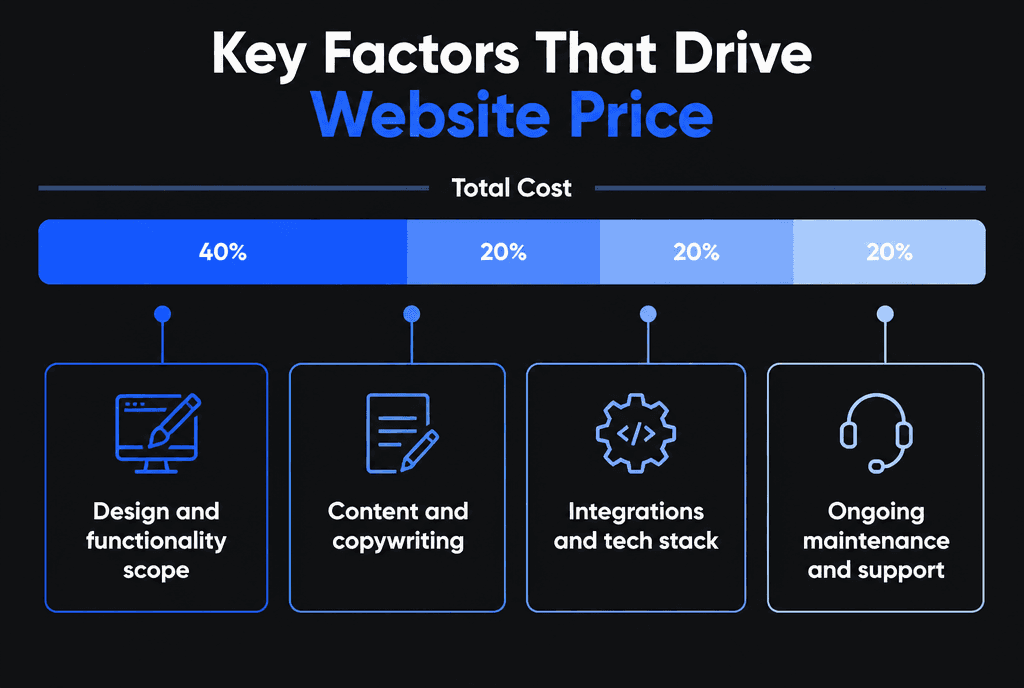
Scope of design and functionality: a 10-page site with two templates costs less than a 6-page site with six unique layouts and animations.
Content and copywriting: writing, editing, photography and video add cost if you do not supply them.
Integrations: CRM, booking, payments, ERP or custom APIs each add development and testing time.
Platform: WordPress, Shopify, a headless CMS or fully custom code have different build and licensing costs.
Maintenance and support: some quotes include ongoing care; others do not.
How do costs differ by type of website?
Brochure and lead generation sites are the least expensive, e-commerce sites cost more because of catalogs, checkout and integrations, and web applications cost the most because they involve custom logic, user accounts and security work.
Small business or service site: $5,000 to $15,000
Content-rich marketing site or blog: $10,000 to $30,000
E-commerce store: $10,000 to $50,000+, plus platform fees; Shopify's pricing page lists plans from $29 a month
Membership, booking or directory platform: $20,000 to $75,000
Custom web application or SaaS: $50,000 to $250,000+
See our full web development cost breakdown for line-item estimates.
What ongoing costs should you plan for?
Plan for hosting, domain, software and plugin licenses, security and update work, backups and continuous improvement. A common planning figure is 10 to 20% of the build cost per year.
Security updates are not optional. WordPress, for example, publishes a hardening guide because unpatched sites are a frequent target, and the OWASP Top 10 lists the most common web application risks.
What is the ROI of paying the right price?
A website that generates leads or sales pays for itself; one that looks fine but does not convert is expensive at any price. Judge quotes by expected business results, such as leads per month, conversion rate and average deal value.
Simple ROI check:
Expected monthly leads from the site: 20
Close rate: 25%, so 5 new customers
Average customer value: $2,000, so $10,000 a month
A $15,000 build pays back in under two months if those numbers hold

How do you budget wisely for a custom website?
Start from business goals, list must-have and nice-to-have features, ask for itemized quotes, and phase non-essential features after launch. Clear content and decisions before development starts save the most money.
Write down the site's top three goals and the actions visitors should take.
Separate launch features from phase-two features.
Prepare content early; content delays are the most common cause of budget overruns.
Ask what is not included, such as copywriting, stock images, SEO and training.
Learn what to expect when you pay for custom web development, and read how to get a custom website for less if budget is tight.

Why are very cheap websites often more expensive later?
Cheap builds often skip planning, speed, SEO, accessibility and security, which leads to poor results and expensive rebuilds. The real cost includes lost leads while the site underperforms.
Read why cheap websites cost more in the long run and the risks of website builders versus developers.
How do freelancers, agencies and in-house teams compare on cost?
Freelancers usually cost least per project but cover every role alone, agencies cost more but bring a team and dependable support, and in-house developers make sense only when you have continuous development work.
Labor drives the price in every model. The U.S. Bureau of Labor Statistics lists 2025 median pay for web developers and digital designers at $99,520 a year, or $47.85 an hour, before benefits, tools and overhead. An agency's rate includes design, project management, quality assurance and support, which is why it is higher than a single developer's wage. Hiring in-house adds salary, benefits, equipment and management time, so it rarely makes sense for a single website project. Compare options on total cost to reach your goal, including how much of your own time each one requires.
Which features add the most cost?
Custom functionality and integrations add the most: booking systems, member portals, e-commerce with complex catalogs, calculators, multilingual content, custom databases and connections to CRMs or ERPs.
Each feature needs design, development, testing and maintenance. Typical cost drivers include:
Unique page templates: every distinct layout adds design and build time
E-commerce complexity: large catalogs, variants, subscriptions or B2B pricing
Integrations: CRM, ERP, payment gateways, booking and marketing tools
User accounts: logins, permissions and dashboards
Content creation: copywriting, photography and video
Compliance: accessibility testing, privacy and security requirements
Ask for a line-item estimate so you can see which features drive the total and decide what can wait for a later phase.
What does a typical timeline and payment schedule look like?
Small business sites usually take six to twelve weeks, larger custom sites three to six months. Payments are commonly split into a deposit, a milestone payment at design approval and a final payment at launch.
A milestone-based schedule protects both sides: you pay as you see progress, and the team is paid for completed work. Delays usually come from content and approvals rather than development, so prepare copy, images and decision-makers before the project starts.
How can you reduce costs without hurting results?
Limit unique templates, provide your own content, choose a mainstream platform, phase advanced features and consolidate feedback. Never cut speed, mobile design, accessibility, SEO foundations or tracking.
Our guide to affordable custom web development covers these strategies in detail, and cost-effective web development explains where businesses most often overpay.
How should you compare quotes?
Give every provider the same written brief, then compare scope, process, timeline, ownership and support line by line. Price differences usually reflect differences in what is included.
A quote that seems cheap may exclude copywriting, SEO setup, testing or post-launch support, which you then pay for separately. A quote that seems expensive may include strategy and ongoing optimization that produce better results. Our guide to choosing the right web development company lists the questions to ask.
What ongoing costs come after launch?
Expect hosting, domain renewal, software licenses or apps, security updates, backups and content changes. Many businesses budget 10% to 20% of the build cost per year for maintenance and improvements.
Budgeting for maintenance from the start keeps the site fast, secure and current, and avoids the emergency costs of fixing a neglected site.
Is the cheapest platform always the cheapest website?
No. A platform with low upfront cost can be expensive to run if it needs many paid apps, custom workarounds or a rebuild when you outgrow it. Compare platforms on three-year total cost, not launch price.
WordPress is free software but needs hosting, maintenance and sometimes premium plugins; Shopify has monthly plans and app fees but handles hosting and security; site builders are cheap to start but can limit growth. Our comparisons of Shopify vs WooCommerce and website builders vs web developers explain the trade-offs.
How do you get an accurate quote?
Share your goals, sitemap, examples of sites you like, required features and integrations, content status and timeline. The more specific the brief, the more accurate and comparable the quotes.
Our custom web development team provides itemized estimates. Start with a free consultation through our web development page.


