
E-commerce website development to increase sales is mostly about removing friction between interest and payment. Online shopping keeps growing: the Census Bureau reports e-commerce made up 16.4% of U.S. retail sales in Q2 2026, not seasonally adjusted. These eight upgrades are the ones we prioritize for online stores at Savoir Management.
Why do online stores lose sales they already earned?
Most lost sales happen after shoppers show interest: in product pages that leave questions unanswered and in checkouts that add surprise costs or steps. Baymard Institute's research puts the average documented cart abandonment rate at 70.22%.
See Baymard's cart abandonment research for the reasons shoppers give, from extra costs to forced account creation.
Upgrade 1: Why should you redesign the checkout first?
Checkout fixes recover revenue from people who already decided to buy. Offer guest checkout, show all costs early, add wallet payments and remove unnecessary fields.
Guest checkout by default
Shipping costs shown on product and cart pages
Apple Pay, Google Pay and PayPal options
Address autocomplete and fewer form fields
Upgrade 2: Is your store truly mobile-first?
Design product listing, product and checkout pages for thumbs first: large tap targets, sticky add-to-cart, fast images and wallet payments. Most store traffic comes from phones.
Pew Research Center reports 91% of U.S. adults own a smartphone. Our mobile-responsive development guide covers the details.

Upgrade 3: How much does speed matter for stores?
Shoppers abandon slow pages, especially on mobile. Optimize images, limit apps and scripts, and meet Core Web Vitals targets on product and collection pages, not just the homepage.
Targets from web.dev: LCP within 2.5 seconds, INP of 200 milliseconds or less and CLS of 0.1 or less. See our site speed guide.
Upgrade 4: Which integrations and smart tools pay off?
Email and SMS automation for abandoned carts and post-purchase flows, inventory sync, reviews platforms and analytics with e-commerce events pay off fastest.
Track view_item, add_to_cart, begin_checkout and purchase with Google Analytics recommended events to see exactly where shoppers drop off.

Upgrade 5: What makes a product page convert?
Great product pages answer every buying question: multiple photos and video, clear price and variants, delivery dates, returns policy, size or fit guidance, reviews and related products.
Place reviews and shipping information near the add-to-cart button, and show stock and delivery estimates honestly.
Upgrade 6: Which conversion-boosting features work?
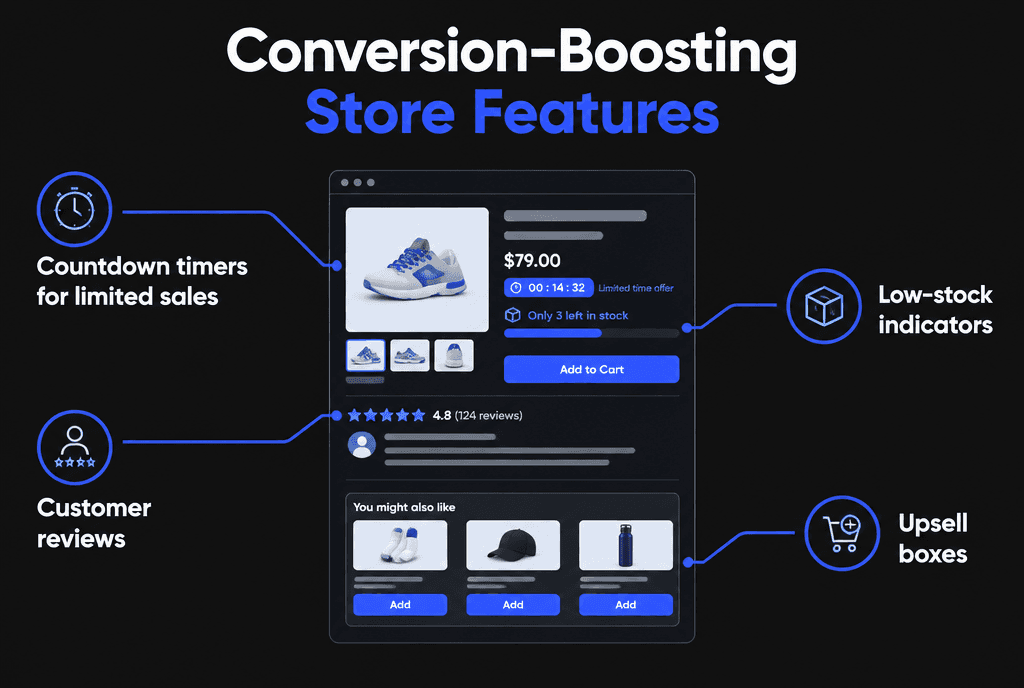
Honest urgency and proof features work: real countdowns for sales, accurate low-stock messages, customer reviews and relevant upsells or bundles. Fake urgency backfires.
Upgrade 7: How do structured data and feeds increase visibility?
Product structured data and a Google Merchant Center feed give Google accurate price, availability and review information, making products eligible for richer search results and Shopping placements.
Follow Google's guides to product structured data, e-commerce SEO best practices and the Merchant Center product data specification.
Upgrade 8: Why does accessibility matter for online stores?
Accessible stores let every shopper browse and pay, including people using screen readers or keyboards, and reduce legal risk. Labeled forms, alt text, contrast and keyboard-friendly checkout are the essentials.
Use WCAG as the standard, and read our guide to ADA-compliant web development.

Upgrade 9: How does on-site search increase sales?
Shoppers who use search usually know what they want. Fast, typo-tolerant search with autocomplete, product suggestions and useful filters helps them find it before they give up.
Review your on-site search reports for queries that return no results, then fix them with synonyms, redirects to relevant categories or new products. Show product images and prices in search suggestions, and let shoppers filter results by the attributes they care about, such as size, color, price and availability. On mobile, make the search bar easy to find at the top of the page.
Upgrade 10: Why does the post-purchase experience matter?
What happens after checkout decides whether a customer buys again. Clear confirmations, shipping updates, easy returns and helpful follow-up emails build loyalty and reviews.
A strong post-purchase journey includes an order confirmation with delivery expectations, tracking updates, product care or usage tips, a review request after delivery and a reorder or complementary product suggestion at the right time. Make returns simple and clearly explained, because a smooth return often keeps a customer who might otherwise leave for good.
How do product reviews increase conversions?
Reviews answer questions your product page cannot, show social proof and reduce risk. Collect them systematically, display ratings near the price and add-to-cart button, and let shoppers filter reviews by topic or rating.
Send review requests automatically after delivery, make submitting easy on mobile and allow photo reviews. Respond to negative reviews constructively; shoppers trust stores that handle problems openly. Product structured data can include review ratings where Google's product structured data guidelines allow, which may make products eligible for review stars in search results.
How do returns policies affect sales?
Clear, fair returns policies reduce purchase anxiety, especially for apparel, footwear and higher-priced items. Show the policy near the add-to-cart button and at checkout, in plain language.
Shoppers often check returns before buying from an unfamiliar store. State the return window, who pays return shipping, condition requirements and how refunds are issued. A slightly more generous policy can increase conversions enough to outweigh extra returns, but measure both before committing.
How do you prioritize upgrades using funnel data?
Track each step from product view to purchase, compare conversion rates between steps and fix the biggest drop-off first. Data shows where upgrades will pay back fastest.
Use Google Analytics e-commerce events such as view_item, add_to_cart, begin_checkout and purchase. If many shoppers view products but few add to cart, improve product pages and pricing information. If they add to cart but do not start checkout, look at shipping costs and cart clarity. If they start checkout but do not finish, simplify the checkout and add payment options. Segment by device, because mobile often reveals problems desktop hides.
How often should you revisit store performance?
Review key metrics weekly and run a deeper audit each quarter or after major changes, such as a new theme, app or payment provider. Small issues compound quickly in e-commerce.
A monthly checklist might include speed on top product pages, checkout completion rate, failed payments, search queries with no results, return reasons and review ratings. Fixing small problems early protects revenue every day. If you are planning a new build, our guide to building an e-commerce website fast that converts covers launch priorities.
How does personalization help online stores?
Personalized recommendations, such as "frequently bought together," recently viewed items and related products, help shoppers discover more and raise average order value. Start with simple, proven recommendations before complex personalization.
Most e-commerce platforms and apps offer recommendation features that use browsing and purchase data. Place them where they help rather than distract: related products on product pages, complementary items in the cart and personalized suggestions in post-purchase emails. Measure their effect on average order value and conversion rate, and remove widgets that slow pages without adding revenue. Respect privacy by following your policy and applicable laws when using customer data.
How do shipping options affect conversions?
Unexpected shipping costs are a common reason shoppers abandon carts. Show shipping costs or thresholds early, offer a free shipping threshold if margins allow and give realistic delivery dates.
A banner showing the free shipping threshold, a shipping estimate on product pages and clear delivery dates at checkout all reduce surprises. Test thresholds carefully: setting one slightly above your average order value can raise order sizes while keeping shipping costs manageable. Baymard's cart abandonment research lists extra costs among the top reasons shoppers leave.
How do you decide which upgrade to do first?
Measure the funnel, then fix the biggest drop-off with the least effort. For most stores that means checkout and mobile speed before redesigning the homepage.
If you are choosing a platform, read Shopify vs WooCommerce. For launching a new store fast, see how to build an e-commerce website that converts. Drive traffic with Meta ads for e-commerce, and let our Shopify development team handle the build.


