
The Bing Ads vs Google Ads question matters most to small businesses with limited budgets. Google is the default choice, but Microsoft Advertising (formerly Bing Ads) can deliver cheaper conversions for the right audiences. This comparison uses current market share data and platform documentation to help you decide where to spend first, and how to use both profitably.
Why do many small businesses waste money before seeing ROI?
Most small businesses lose money on paid search because they launch without conversion tracking, bid on broad keywords and judge platforms by cost per click instead of cost per customer. Choosing between Google and Bing matters less than fixing those basics.
Whichever platform you choose, set up conversion tracking first, use intent-driven keywords and review the search terms report every week.

How big is Bing compared with Google?
Google handles most U.S. searches. In September 2026, StatCounter measured Google at 85.19% of U.S. search engine market share across all devices, compared with 9.89% for Bing. On desktop the gap narrows: Google 74.71% and Bing 18.8%.
Those figures come from StatCounter's U.S. search engine market share and U.S. desktop market share data. Microsoft Search ads can also appear on partner sites such as Yahoo, AOL, DuckDuckGo and Ecosia, according to Microsoft Advertising, which extends reach beyond Bing itself.
Which platform has better ROI?
Google usually wins on volume, and Microsoft Advertising often wins on cost per click because fewer advertisers compete for the same keywords. ROI depends on whether your buyers search on desktop, work in business settings or use Microsoft devices.
Search volume: Google is far larger.
Competition: usually lower on Microsoft, which can lower CPC.
Audience: Microsoft skews toward desktop and work-related searches.
Targeting: Microsoft offers LinkedIn profile targeting; Google offers broader audience and YouTube options.
Setup effort: Microsoft can import Google campaigns, so a second channel takes hours, not weeks.

When should you use Google Ads?
Use Google Ads first when you need volume, sell to consumers on mobile, run local services, or want access to YouTube, Maps and Shopping. Its larger audience makes it the faster way to learn which keywords convert.
Google also offers the most mature automation, from Smart Bidding to Performance Max. Start with our guide to launching a profitable Google Ads campaign.
When should you use Microsoft Advertising?
Add Microsoft Advertising when your Google campaigns are profitable and you want more conversions at similar or lower cost, when you sell to businesses, or when your buyers search mostly on desktop computers at work.
Microsoft's audience targeting tools include LinkedIn profile targeting by company, industry and job function, which is valuable for B2B services. Its import tools bring over campaigns from Google Ads, Meta Ads and Pinterest Ads.

How should a small business split budget between Google and Bing?
Start with 100% on Google until you have profitable campaigns, then import into Microsoft Advertising with 10 to 20% of the search budget. Shift more toward whichever platform delivers the lower cost per customer.
Launch on Google and run it until cost per conversion is stable.
Import the best campaigns into Microsoft Advertising.
Lower bids slightly to start, then adjust based on conversions.
Review both monthly and move budget toward the better cost per customer.
How do you make either platform work?
Use intent-driven keywords, track every conversion, test ads constantly and review data weekly. These habits matter more than the choice of platform.
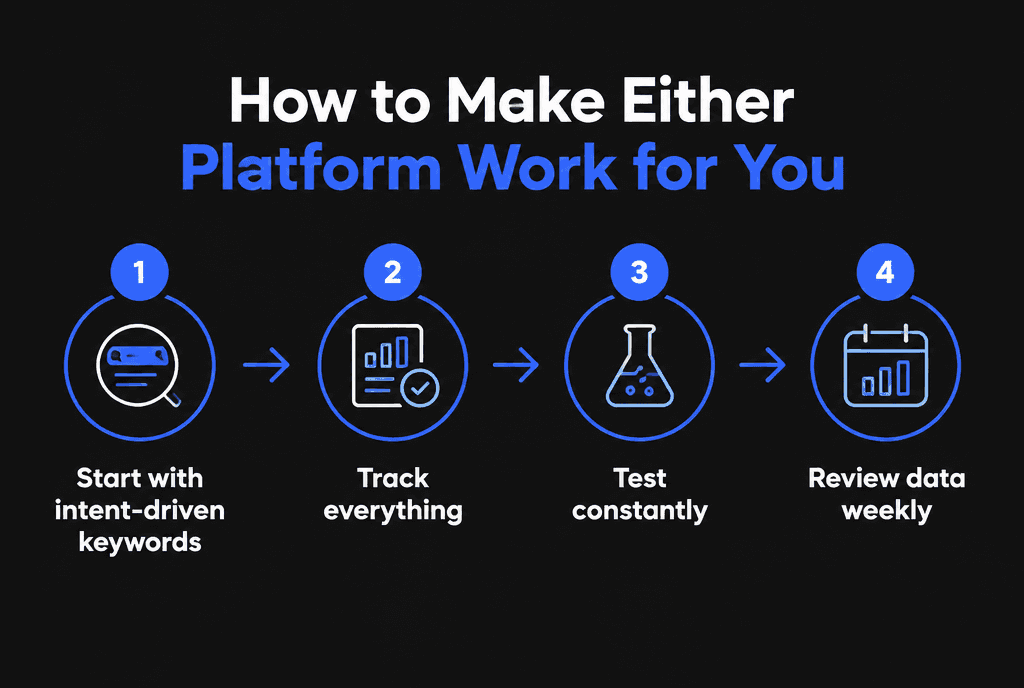
Use phrase and exact match for your highest-intent terms.
Add negatives every week.
Send each ad group to a matching landing page.
Judge results by cost per lead or sale.
How do you import Google Ads campaigns into Microsoft Advertising?
Microsoft Advertising can import campaigns directly from Google Ads, including keywords, ads, bids and many settings. Importing saves setup time, but you should review budgets, bids, targeting and tracking afterward rather than assuming everything translates perfectly.
Microsoft's import tools support importing from Google Ads and other platforms, and scheduled imports can keep changes in sync. After importing:
Check daily budgets, which may need to be lower to match Bing's smaller search volume
Review bids and bidding strategies; costs and competition differ by keyword
Confirm conversion tracking with Microsoft's own tag, not just the Google tag
Re-check location, language and device targeting
Review ad assets and extensions, which have different names and options
Importing your best-performing Google campaigns first is usually the quickest way to test whether Bing adds profitable volume.
Who searches on Bing, and why does it matter?
Bing's share is higher on desktop than on mobile. In the U.S., StatCounter reported Bing at 18.8% of desktop search in September 2026, compared with 9.89% across all devices, so businesses whose buyers search at work on desktop computers often see the most value.
Those figures come from StatCounter's desktop search engine market share and all-device share for the United States. Microsoft's search network also includes partner sites, so ads can appear beyond Bing itself. B2B services, professional services and products researched during the workday are common fits. Test with real data: your own conversion results matter more than averages.
How does LinkedIn profile targeting help B2B advertisers?
Microsoft Advertising lets you adjust search ads using LinkedIn profile data such as company, industry and job function. That can focus spend on decision-makers, which is hard to do on most search platforms.
Microsoft describes LinkedIn profile targeting among its audience targeting tools. A practical use is to raise bids for searchers in your target industries or job functions while keeping broader reach. For companies selling to businesses, this alone can justify a Bing test. Our B2B web development guide covers how to build landing pages for those decision-makers.
How do you track and compare ROI across both platforms?
Track conversions separately on each platform with its own tag, and also track them in your analytics and CRM using UTM parameters. Compare cost per conversion and revenue per conversion side by side, not clicks or impressions.
Each platform reports conversions using its own attribution, so platform numbers can overlap or differ. A neutral view in Google Analytics and your CRM shows which platform's leads actually become customers. Review both monthly and move budget toward the platform with the better cost per customer, while keeping enough spend on the other to stay visible on profitable terms.
What mistakes do businesses make when running both?
Copying Google budgets to Bing unchanged, not installing Microsoft's conversion tag, ignoring search partner performance, and judging Bing too quickly on small volumes.
Bing campaigns usually generate fewer clicks, so they need longer to collect meaningful data. Review search partner traffic separately and exclude poor performers. Keep negative keyword lists in sync across both platforms, since wasted search terms cost money everywhere.
How do landing pages affect ROI on both platforms?
The same landing page serves both platforms, so improving it raises ROI everywhere. Message-matched, fast pages with a clear offer lower cost per conversion on Google and Bing alike.
Desktop-heavy Bing traffic may read more before converting, so detailed service information, pricing guidance and proof help. Our guide to high-converting landing pages explains how to build pages that work for both.
How should a small business test Microsoft Advertising?
Import your best Google Search campaign, set a modest budget, install Microsoft's conversion tag and run the test for at least several weeks. Compare cost per conversion and lead quality with Google before deciding how much to invest.
A fair test needs enough clicks to judge. Because Bing traffic is smaller, a few days rarely tells you much. Keep the same landing pages and offers so the only real difference is the platform. If Bing produces conversions at a similar or lower cost, scale it gradually alongside Google. If it produces few conversions after a fair test, keep a small brand campaign running so competitors cannot take your name, and focus most budget on Google. Either way, you will have made the decision with your own data rather than general advice.
Microsoft's search ads overview explains where ads can appear across its network, which helps when reviewing placement and partner reports during the test.
What is the bottom line on Bing Ads vs Google Ads?
Google Ads should be the first paid search channel for nearly every small business because of its reach. Microsoft Advertising is usually the best second channel: easy to launch from imported campaigns, often cheaper per click and uniquely useful for B2B targeting.
Want help running both? Our Google Ads management team manages Google and Microsoft campaigns together. For local service businesses, read Google Ads for local businesses, and for cost control see how to lower Google Ads CPC.


